Forever After Decline
Progressive Christianity and a generational Imagination

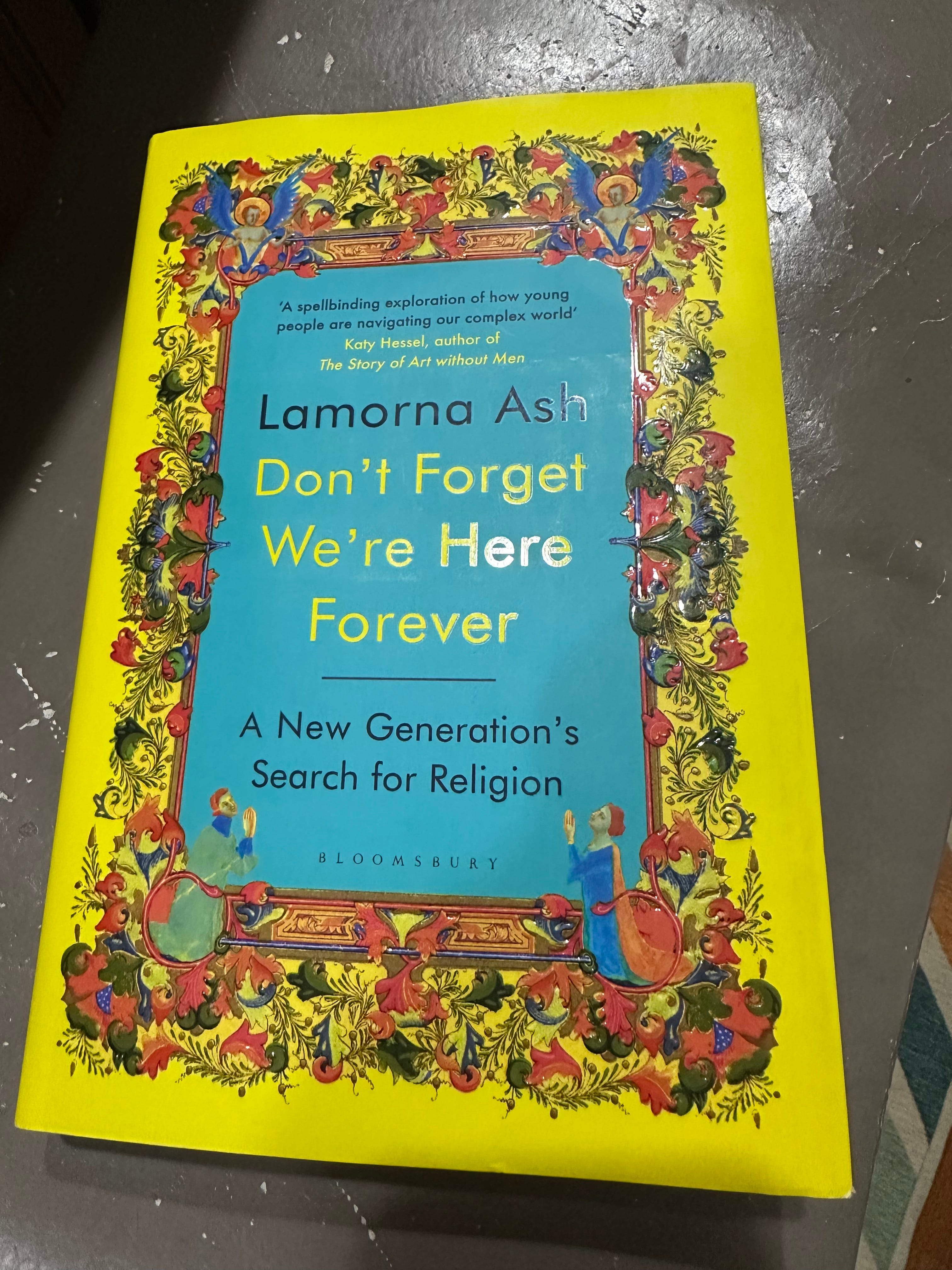
In Don’t Forget We’re Here Forever, Lamorna Ash listens her way into belief. Her book is not an apologetic in the conventional sense; it is closer to fieldwork conducted at the edge of transcendence, as much auto-ethnography in the field as anything. What emerges from her conversations with young Christians in the United Kingdom is an intense searching with a seriousness about God that feels unembarrassed by metaphysics and unpersuaded by past cynicisms.
Given how much in American contexts we ring hands about decline, I found it refreshing to read someone not nostalgic for lost Christendom (although she does have a special place in her heart for the Quakers). Those she interviews are also not interested in dismantling Christianity. They are for the most part asking whether it can still bear weight of the glimpses of the divine that have broken through into their lives in wildly idiosyncratic ways.
Two paragraphs from her introduction to illustrate the point:
To return to Christianity, Grace Davie, a professor of sociology and religion at the University of Exeter, believes there are two possible routes the next generation could take in relation to the Christian faith in Britain. Which of these we end up with depends on Christianity’s essential nature. If it is nothing more than an outdated tool humans once used when there was nothing else to help them through times of crisis, then the number of Christians in the UK will continue dwindling to nothing. If religion is a more expansive concept, incorporating questions about ‘individual and social health, about the purpose of existence, the future of the plaet and the responsibilities of humanity both to fellow humans and the Earth itself,’ so Davie frames it, then a very different kind of future opens up ahead.
When we discuss religion together, my friends and I, those interactions no longer look as they did back when we were in our late youths. Here comes our unsteady, discordant, over-stimulated, porous-bordered generation. We are no longer waiting to inherit the world. The world is here and now we’re wondering what of it we are supposed to retain for the coming generations, how to leave a legacy which is not only further destruction and conflict. We would like something to hold on to, or at least, the people I met during my research were seeking something to hold on to. I know I am looking for something like that.1
These two paragraphs give you a wonderful sense of how the book proceeds. Ash listens very carefully to her friends and the people she interviews. She also records how she is responding to being in those conversations, just in the same way she is reminded repeatedly that if she puts herself in the way of Christianity, perhaps it might make her a Christian.
These questions have been with me since visiting campus ministry at Texas Lutheran University a few weeks back. Anyone who works in progressive Christian spaces knows the asymmetry, even apparently now on the campuses of the mainline denominations, between progressive and conservative Christian groups, particularly though not exclusively in the South. Conservative ministries arrive with numbers, funding, clarity, and a confidence that their theology maps cleanly onto political identity. Progressive ministries arrive with discernment, nuance, and a commitment to complexity. I notice this even while observing the disparity in numbers in campus ministry here at the University of Arkansas.
One side promises solidity, salvation and status; the other offers spaciousness, service and solidarity.
In an anxious generation, those first grouping of alliterated S’s has obvious appeal.
And yet the sociological picture is more complicated than the dominance of conservative campus ministries might suggest. As just one demographic illustration, this chart from Ryan Burge shows a dramatic contraction in the proportion of adults who are white Protestant or white Catholic Democrats: from 41% of the population in 1972 (24% white Protestant Democrats and 17% white Catholic Democrats) to under 11% in 2024 (6.3% and 4.4%, respectively).
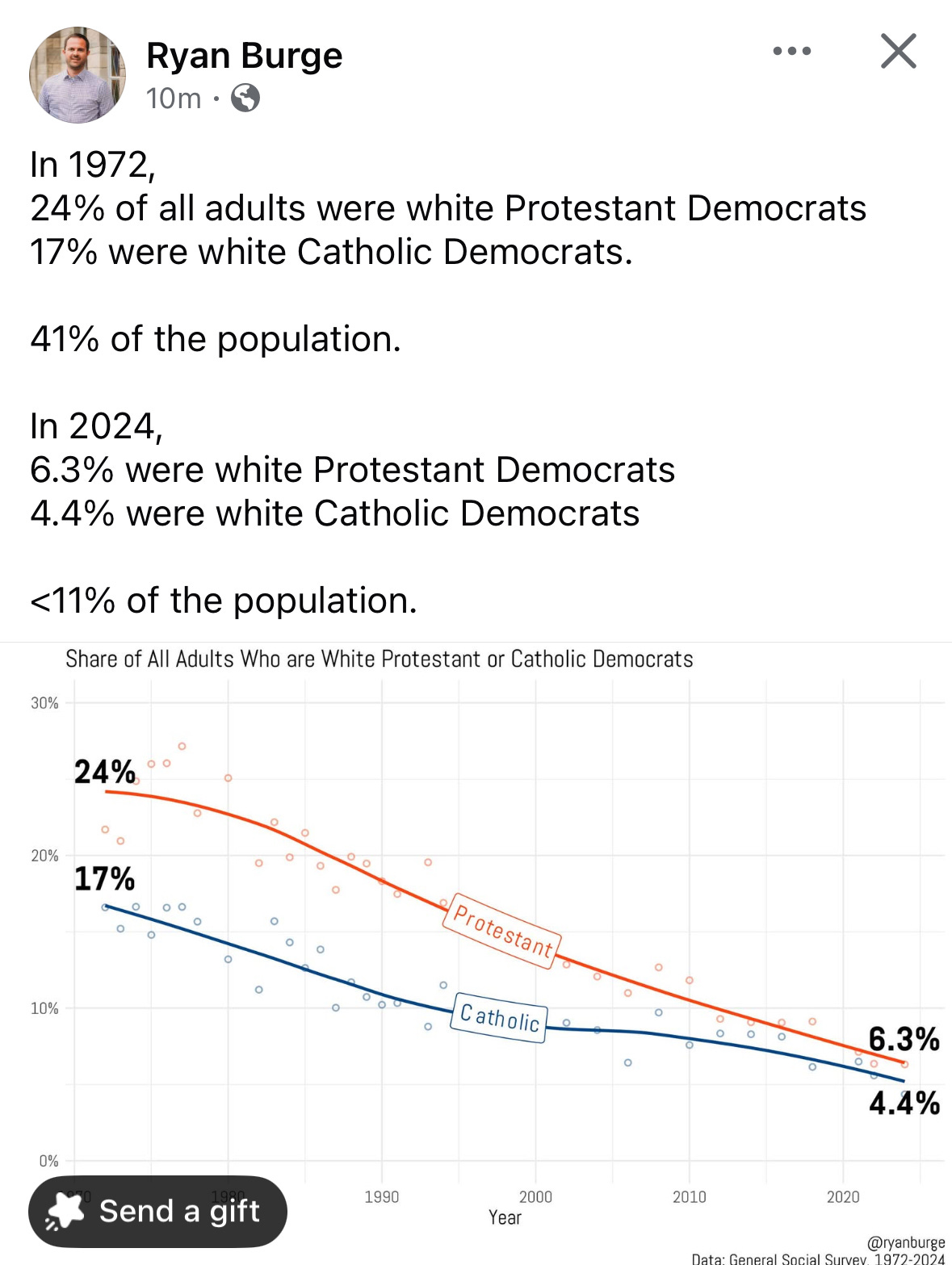
The temptation is to narrate this as theological failure. Liberal Christianity empties pews; conservative Christianity thrives. But that reading flattens what the data actually measure (and actually other data from Burge shows that some conservative Christianity segments aren’t declining as fast as the others).
The graph does not chart church attendance or spiritual vitality. It charts partisan identification within racialized Christian categories over half a century marked by demographic change and political realignment. What appears at first glance to be “the decline of liberal Christianity” is, in large part, the story of white Christian identity detaching from Democratic affiliation amid the culture-war consolidation of the 1990s and 2000s.
I’m thinking about this analysis as I read Lamorna’s ethnographic account.
If we mistake political sorting for theological exhaustion, we will assume that the generational cohort Ash encounters is statistically impossible, that young adults cannot be drawn to a progressive Christian vision because “liberal Christianity is dying.” But the campus ministry moment described in another place, “As universities shutter DEI offices, progressive Christian groups open their doors,” complicates that assumption. What we are seeing is not the disappearance of faith, but its relocation away from inherited partisan blocs and toward smaller, more intentional communities where belonging is theological before it is political.
The contraction of a demographic category is not the same thing as the evaporation of spiritual hunger.
If progressive Christianity internalizes the decline narrative too quickly, it risks confusing institutional contraction with theological infertility. Those are not the same thing. Institutional forms can thin out while theological imagination thickens.
The article in Religion News Service describes progressive campus ministries stepping into spaces vacated by the dismantling of university DEI offices. At Ohio State, Jacob’s Porch2 has become a gathering place for students (many LGBTQ) who lost institutional belonging when identity-based centers were shuttered. One campus minister described the moment as a juncture “where we can do stuff the university can’t do anymore… not just a place of religious conversion, but of deep social justice.”
For decades, progressive Protestantism outsourced3 aspects of its moral vision to adjacent institutions: universities, nonprofits, public agencies. When those institutions retreat from practices of belonging, the church is forced to remember that hospitality is not an optional program but a theological claim grounded in sacramaental commitments like baptism as a new kinship and Eucharist as a politics of shared bread.
The generational question, then, is less about whether young adults are attracted to “liberal” Christianity and more about whether progressive churches can (re-)articulate their commitments as theological rather than managerial. And not just theological but if I’m reading Lamorna Ash correctly: existential.
Conservative campus ministries often present a seamless narrative: moral clarity, doctrinal certainty, communal intensity. That coherence is powerful, often cult-like. Progressive ministries frequently present ethical commitments (LGBTQ affirmation, racial justice, climate action) without always articulating the doctrinal architecture beneath them, and because they serve many Christians emerging from religious contexts of harm, they move with some skepticism toward charismatic leadership. The result can feel reactive rather than radiant (famously in these contexts sometimes people talk about “de-”construction), especially in a highly pressurized political and cultural context where those commitments are under direct assault.
Ash’s interlocutors suggest another possibility. The young Christians she meets are not seeking a diluted faith. They are drawn to incarnation, sacrament, prayer, spiritual discipline across a wide spectrum of church traditions. Some are out on retreat at Iona or living the Pascha of the week of Easter. And she herself in her “auto-reporting” describes how conversations with them then shapes her own emerging faith. She mentions at more than one point that what started as anger or frustration with conservative Christianity shifted to a more positive questioning of what she was seeking in her own life.
Here lies the challenge for progressive Christianity in the American context. If it is associated culturally with decline, that may be because it has too often defined itself by negation: not fundamentalist, not authoritarian, not anti-science, not homophobic. These distinctions were necessary, but… they are not sufficient. A generation formed amid climate crisis, racial reckoning, gender expansion, and democratic fragility is not asking for a church that is merely safer. It is asking for one that can name ultimate reality without flinching, and the “auto-question” I’m continually asking myself is whether we are up to the task. As I deepen connections on campus, and with young adults, I ask whether I am up to the task.
The renewal I suspect is possible will not look like a return to 1972 (the year I was born), nor will it reverse demographic shifts captured in Burge’s chart. It may not produce large denominational resurgence. It may instead appear in smaller, ecumenical, experimental communities like the One Church Brighton Lamorna visits at one stage of her research before returning to her local Anglican parish. Perhaps campus groups that host Pride gatherings not as political theater but as sacramental welcome (I witnessed something like this emerging at TLU); congregations that connect creation theology to climate grief and invite all the young environmental studies students to connect; and importantly at least from my perspective, pastors who remain decidedly Christian rather than progressively obtuse, proclaiming the resurrection of Christ without hedging as if it’s just a metaphor, while simultaneously not hedging on what the gospel means in terms of proclaiming progressive values.
If progressive Christianity is to shed its association with decline, it will not do so by softening its theology further. It will do so by deepening it. Which is why I wrote about a book that.
Ash titled her book with eschatological confidence: Don’t Forget We’re Here Forever. Forever is not institutional permanence but participation in God’s future, and I suspect this is the crucial topic around which the vitality of progressive Christianity is going to circle. I once overheard a group of undergrads talk about how they hadn’t been into campus ministry until they learned if they became Christians they could experience “eternal bliss.” I think progressives can potentially have a vision of the future with that same type of energy, probably more communal and in this world4. The decline of a partisan demographic category does not exhaust that horizon, especially given all of Jesus’ teaching about mustard seeds and such.
She adds this footnote on Davie’s Religion in Britain Since 1945: Here Davie seems to predict some of my findings with her hypothesis that, in the coming decades, young people might respond more constructively to questions around religion than the generations which came before them—not ignoring the complex issues involved in religious belief but instead turning to face them directly.
The campus pastor is Grant Eckhart, a friend who I recently interviewed here:
Many of the “secular” institutions progressive Protestants came to trust were themselves the outcome of earlier Christian moral and institutional innovations, gradually translated into public frameworks. Their current precarity invites reconsideration of that genealogy.
Like, for example, the entirety of Victoria Goddard’s speculative fictional work, energized as it is by a Christian eschatology.