
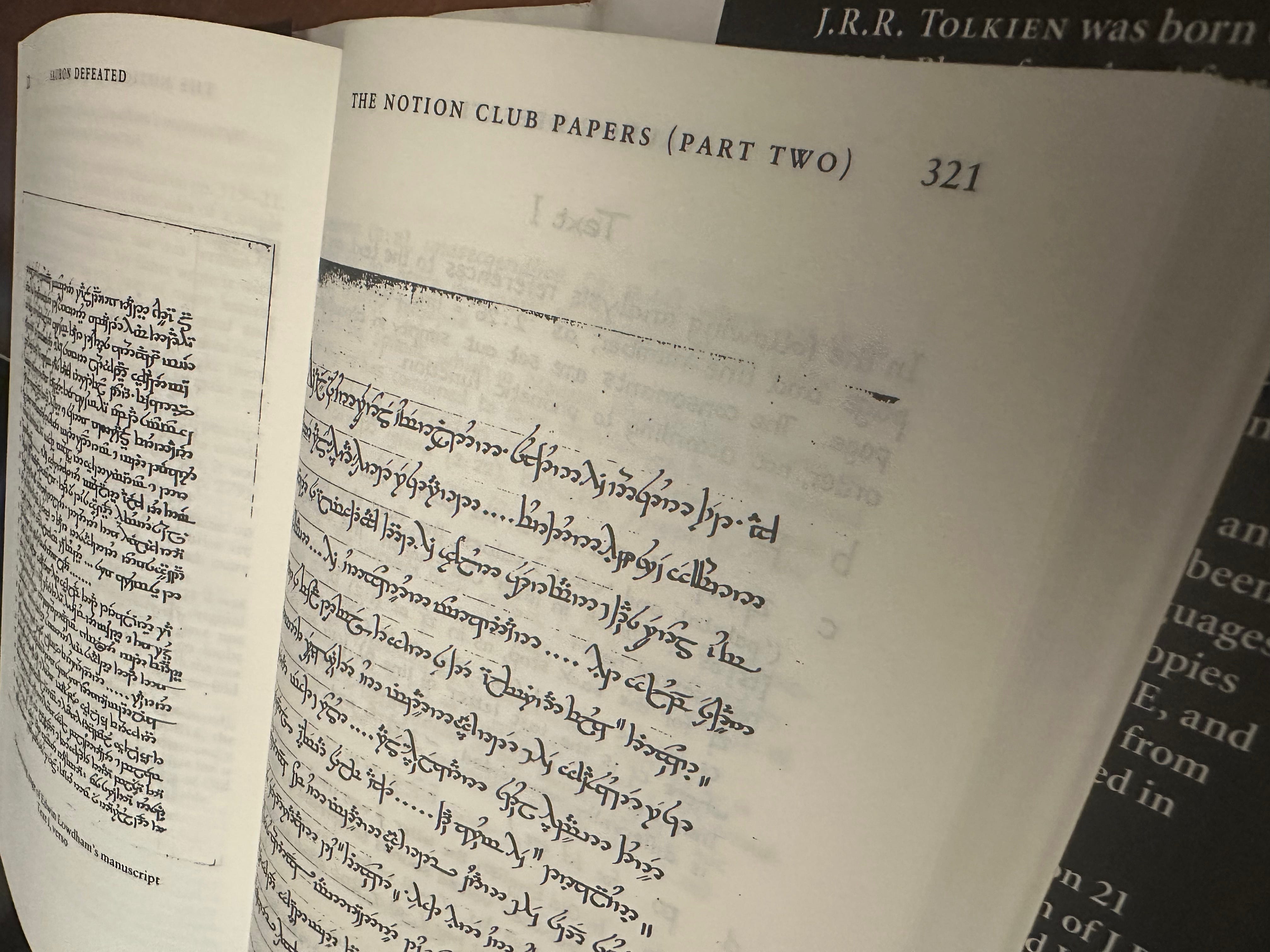
So I was today years old when I discovered that buried at the end of The History of Middle-earth Volume 9 is this wild, unfinished Tolkien time travel novel called The Notion Club Papers. It's about a group of Oxford dons in the 1980s (fictionalized, of course, as Tolkien was writing it in the 1940s—so I guess in a way it’s Tolkien’s version of 1984) who start having increasingly intense dreams and visions, some of them in Quenya and Adûnaic, and begin remembering the downfall of Númenor. Like… Atlantis by way of philology.
Then I remembered that back in Volume 3, The Lays of Beleriand, Christopher Tolkien included an ingenious and sneakily serious fictionalized commentary by C.S. Lewis on The Lay of Leithian (Tolkien's unfinished epic poem about Beren and Lúthien).1 Lewis, in mock-scholarly mode, treats the poem as a recovered text from a lost tradition, offering variant readings, editorial debates, and dry academic footnotes as if he were Beowulf's future commentator.
This is a total rabbit hole.
And at the bottom of that rabbit hole is a dreamscape where time travel, myth, language, and memory all swirl together. It turns out, Tolkien and Lewis were experimenting with something radically ambitious: a mythic framework in which dreams connect generations, ancient languages survive in our unconscious, and Atlantis really did sink beneath the sea—we just remember it differently, dimly, in stories and tongues.
Tolkien’s The Lost Road (started in the 1930s) and The Notion Club Papers (begun in the 1940s) are two iterations of this same impulse. In The Lost Road, a father and son begin sharing dreams that lead them back through history—from modern England to Númenor and ultimately to the Elvish legends. The characters' names shift across eras, but their essence stays the same: Alboin becomes Elendil. The framing device here is dreams passed down through blood memory.
The Notion Club Papers takes the idea further. In it, the protagonist, Alwin Arundel Lowdham (a lightly veiled alter ego for Tolkien himself), starts speaking Quenya during a storm. He and his fellow club members (based loosely on the Inklings) begin to access ancestral memories, including visions of the Downfall. Lowdham's name echoes Ælfwine ("Elf-friend"), the legendary Anglo-Saxon mariner who, in other versions of Tolkien's legendarium, journeys to Elvenhome and becomes the transmitter of Elvish lore to the modern world.
Verlyn Flieger puts it best:
“Had either The Lost Road or The Notion Club Papers been finished, we would have had a dream of time-travel through actual history and recorded myth which would have functioned as both introduction and epilogue to Tolkien's own invented mythology. The result would have been time-travel not on the scale of ordinary science fiction but of epic, a dream of myth and history and fiction interlocking as Tolkien wanted them to, as they might well once have done.”
This is not just literary play. Tolkien and Lewis were trying to re-enchant the modern world, not by escaping it but by uncovering deep continuities between language, story, and spirit. Lewis’s commentary on The Lay of Leithian is an act of literary cosplay, sure, but it’s also a genuine tribute to Tolkien's work. A belief that it deserved the same depth of engagement usually reserved for ancient texts. He saw Middle-earth not just as fantasy, but as a mythic continuum that deserved critical scrutiny.
In other words, this wasn’t Tolkien pretending to write ancient myths. It was Tolkien saying: what if the myths we know are already echoes of something real? What if Elvish languages and Atlantis dreams and Anglo-Saxon poetry are all fragments of a much older story?
And what if fiction is the only way to tell that truth?
This unfinished thread in Tolkien’s work feels like one of the great literary what-ifs of the 20th century. If The Notion Club Papers or The Lost Road had been completed, we might have had a genre-defying epic—part theological speculation, part time-travel novel, part dream-journal, part mythological philology—that linked The Silmarillion and Númenor directly to our modern cultural memory.
But even in their unfinished form, these texts open up questions we still hunger for: Where does meaning live? What do we inherit unconsciously? Can language itself carry memory? Is myth a kind of truth that comes back to us disguised as fantasy?2
And maybe that’s the real trick. The Notion Club Papers may not have been finished, but Tolkien’s dream got out anyway. Especially post-Peter Jackson and with so much of Tolkien influencing gaming and film and television, we’re still having it.
Page 315 and following for those who want to check it out.
All of this and more Tolkien deals with more directly in his On Fairy Stories.
Fringe. A parable of hope and forgiveness for our times.